When they ask how you govern your AI, can you prove it?
Using a CV-screener, a credit scorer or a payroll model, or anything that ranks or scores people? That’s the AI this covers.
Audit Evidence captures each AI-assisted decision as a signed-off evidence pack. So when someone asks, you send the proof instead of scrambling to pull it together.
From £1,200/year. 14-day free trial, no card needed.
Why it matters now
The question usually comes from a customer or an auditor long before it comes from a regulator.
Either way, what counts is whether you can show your work.
First · the question
When someone asks you to prove it
Auditors, customers and your own board increasingly want to see how you govern the AI in your hiring, pay and people decisions: not a policy document, but the evidence behind each decision. Without it, sign-off stalls and the questions keep coming.
Then · the regulator
Up to €15M or 3% of turnover
Under EU AI Act Article 99, breaching high-risk obligations can mean fines of up to €15 million or 3% of global annual turnover, whichever is higher. High-risk obligations apply from 2 December 2027.
The problem
Most teams can’t show their AI governance on demand.
Auditors expect structured, versioned, signed-off evidence, not a folder of Word documents assembled under pressure.
Evidence scattered across systems
SharePoint, email chains, Confluence, IT tickets. When an audit lands, nobody knows where anything is or whether it is current.
Questions you can’t answer yet
Human oversight logs. Override records. Bias audit dates. Most teams find the gaps only after someone asks.
Word documents aren’t evidence
No version history. No sign-off trail. No audit log. What looks like documentation is hard to defend.
How it works
From AI decision to signed-off evidence
A repeatable process your team can run without being compliance specialists.
Register the AI system
Name the system, set its risk tier and assign an owner.
Add the decision
Record the business decision it influences, the jurisdiction and the risk level.
Build the evidence pack
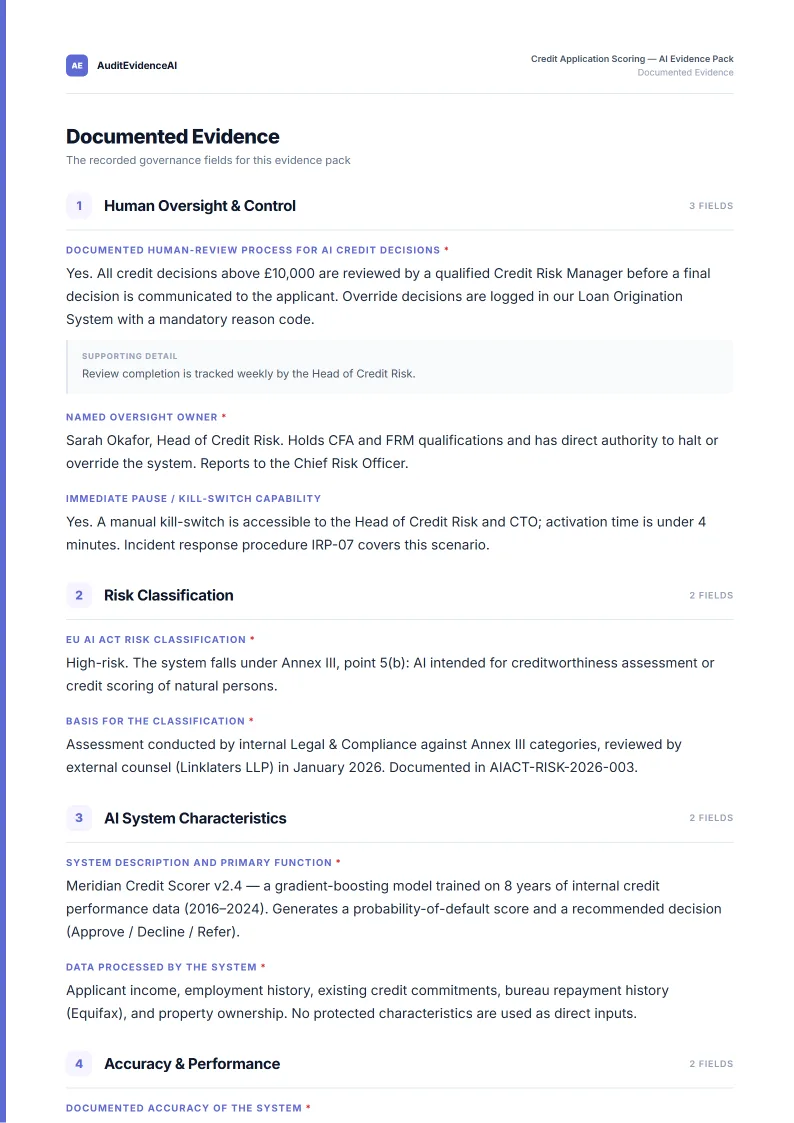
Answer guided questions for your framework and link supporting evidence.
Review and sign off
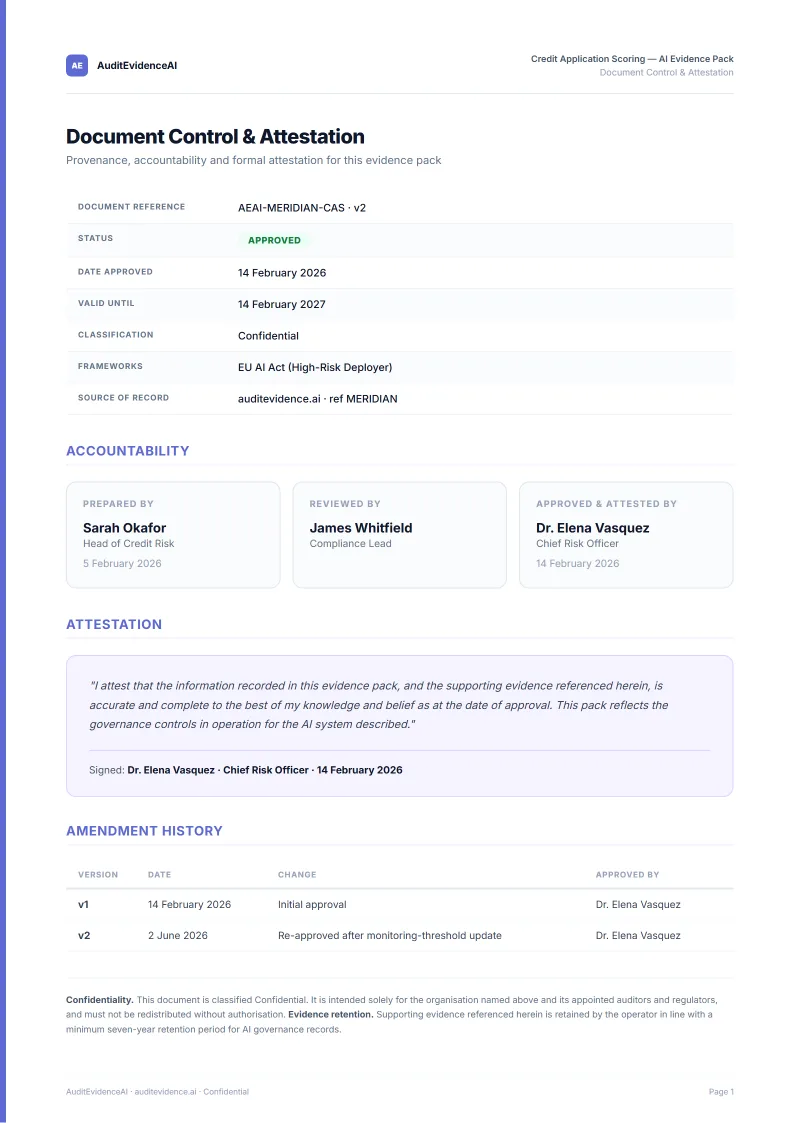
A nominated reviewer approves; name, role and timestamp go into the audit trail.
Export the PDF
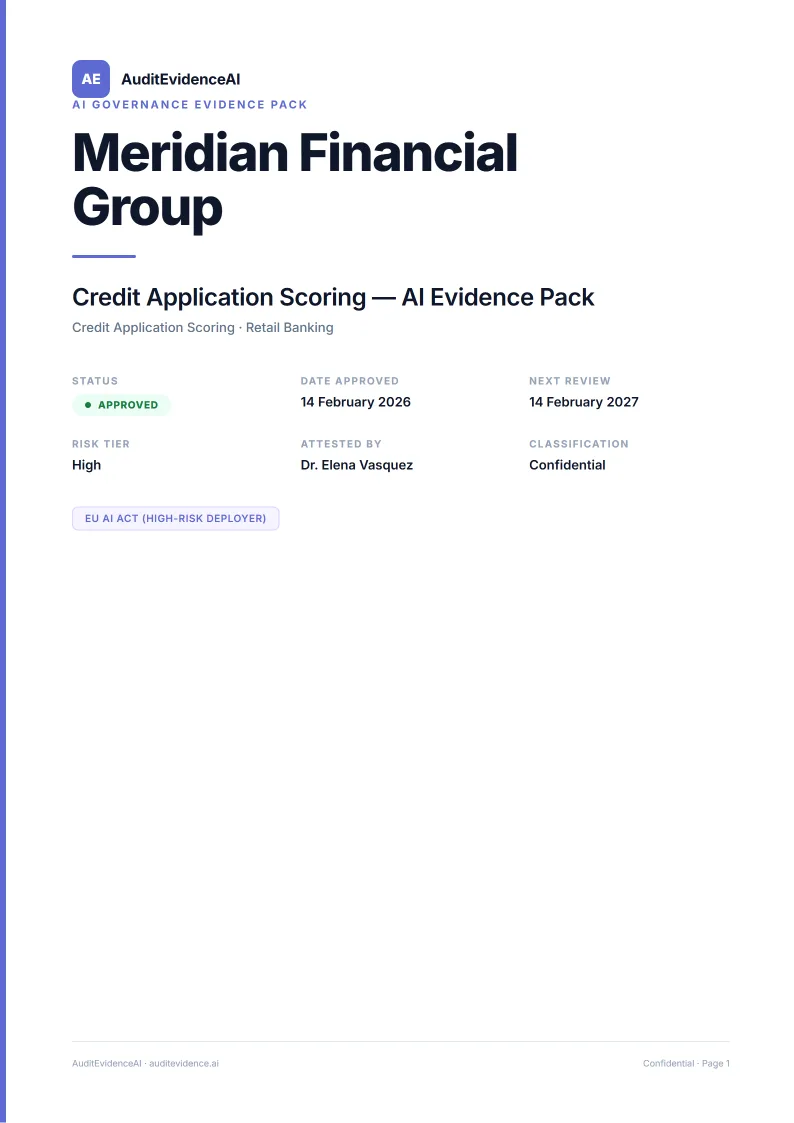
One versioned PDF for internal audit, customers or regulators.
About the readiness score
Readiness measures how complete your evidence is against each framework’s questions. It is not a compliance certification. That judgement stays with your auditor or regulator.
Frameworks covered
What auditors look for. What your pack documents.
Evidence packs built around the documentation each framework expects.
Who builds it
Built by people who’ve sat through these audits
It comes out of 20+ years in global HR, payroll and enterprise compliance, the side of the table that gets the auditor’s questions and has to find the evidence.
Kept current
Templates that move with the regulation
When the rules change, we update the templates: the questions, the guidance, the deadlines. We did exactly that when the EU AI Act high-risk timetable moved in 2026.
Who it’s for
Built for the teams closest to AI decisions
Different functions, same need: evidence that holds up when someone asks.
Evidence AI-assisted hiring decisions, bias audit dates and candidate notices.
Document automated payroll and finance decisions, exception handling and human oversight.
Keep a register of AI systems and the decisions they influence, with evidence ready before anyone asks.
Own the system register: versions, risk tiers, vendors and review cadences.
Have the answer ready before the question lands.
See exactly what an auditor or customer would receive, then build your own.
EU AI Act · NIST AI RMF · ISO 42001 · NYC Local Law 144